

Which print suits your event?
Each print suits a different kind of moment. Thermal suits lots of guests joining quickly, Instax suits colour on a budget, and Polaroid suits fewer, more deliberate photos.
| Look | Picture size | Time to see it | Cost per photo | |
|---|---|---|---|---|
| Thermal photo print | Grainy black and white | 58 mm wide, with your design | About 10 seconds at Monotone | Part of a hired service |
| Instax Mini | Glossy colour | 46 × 62 mm | About 90 seconds | About S$1.20–1.30 in film |
| Polaroid i-Type | Soft colour or black and white | 79 × 79 mm | 10–15 minutes | About S$3.36 in film |
Film prices as of September 2026.
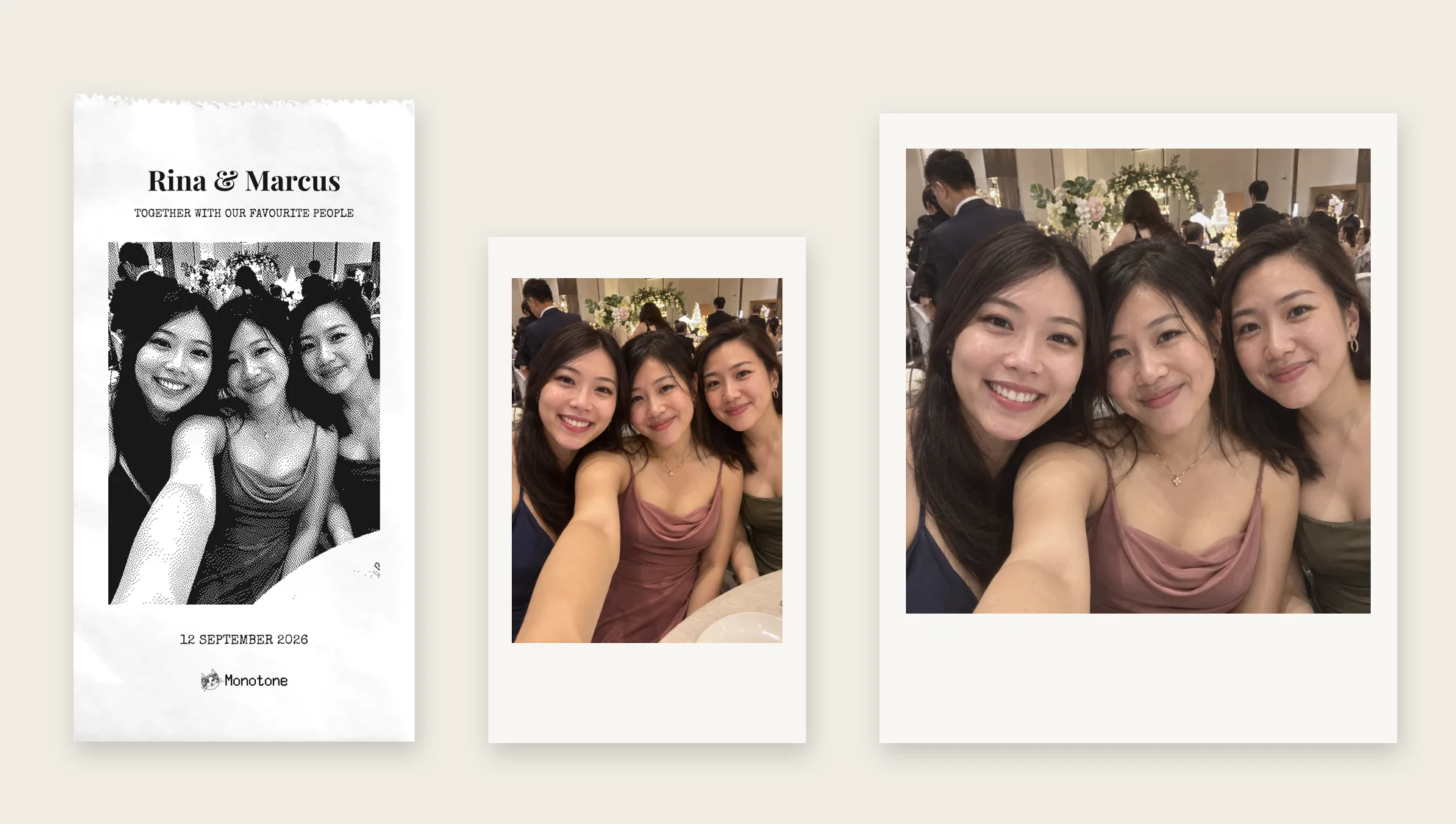
What goes on the print besides the photo?
A thermal print is designed, not just printed. Your names, the date, a short line and artwork can sit around every photo, so each print reads as a keepsake from your event rather than a loose snapshot.
Instax and Polaroid prints carry the photo and a plain white border. Guests can write on the border with a marker, which suits a guestbook, but nothing about your event appears unless someone adds it by hand. See what a thermal print can include.
What is each one like to run at an event?
With Instax or Polaroid, one camera does all the work. Guests take turns, someone reloads film every 10 or 8 shots, and a helper usually minds the camera so it doesn't wander off or run out halfway through dinner.
A thermal photobooth like Monotone works the other way round. Guests use their own phones, so many people can take photos at the same time, and an operator runs the printer. At busy moments, guests may wait a little to collect their print.
- Instax or Polaroid: one shared camera, film changes, a volunteer to mind it
- Thermal photobooth: guests' own phones, prints in seconds, an operator on site
What would 100 photos cost in film?
Say 100 guests each take one photo. On Instax Mini, that's five 20-shot twin packs, about S$120–130 in film. On Polaroid i-Type, it's 13 packs of 8, about S$350. Retakes and blurry shots add to both.
Thermal paper costs a fraction of film, so nobody has to ration shots. A hired thermal photobooth is quoted as a whole service instead: the operator, your print design and the digital guestbook are part of the price. See how pricing works.
Thermal photo prints: fast and black and white
A thermal printer heats coated paper to make the picture, so there's no ink or film. The result is a grainy black-and-white print, closer to a receipt than a glossy photo, and it arrives in seconds.
With a Monotone receipt photobooth, guests take photos on their own phones and collect a 58 mm print about 10 seconds after sending it. Every photo also goes into the host's digital guestbook, so nothing depends on one piece of paper.
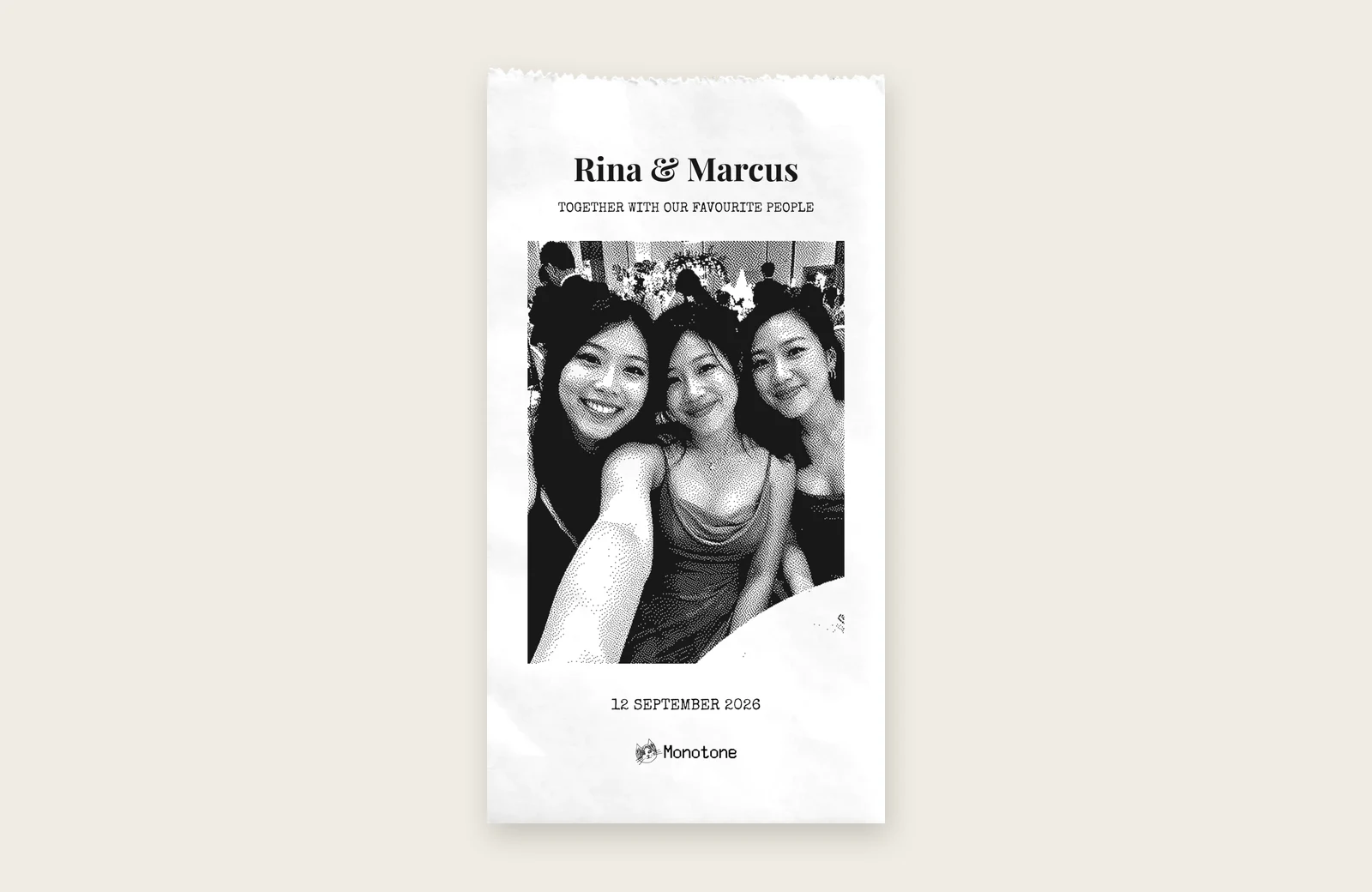
Choose thermal if you want many guests to take part and you like the black-and-white look. The paper is sensitive to heat and sunlight, so how long thermal photo prints last explains how to keep them.
Instax Mini: small colour photos
Instax Mini film gives a colour picture of 46 × 62 mm on a print about the size of a credit card. According to instax, it develops on its own in about 90 seconds.
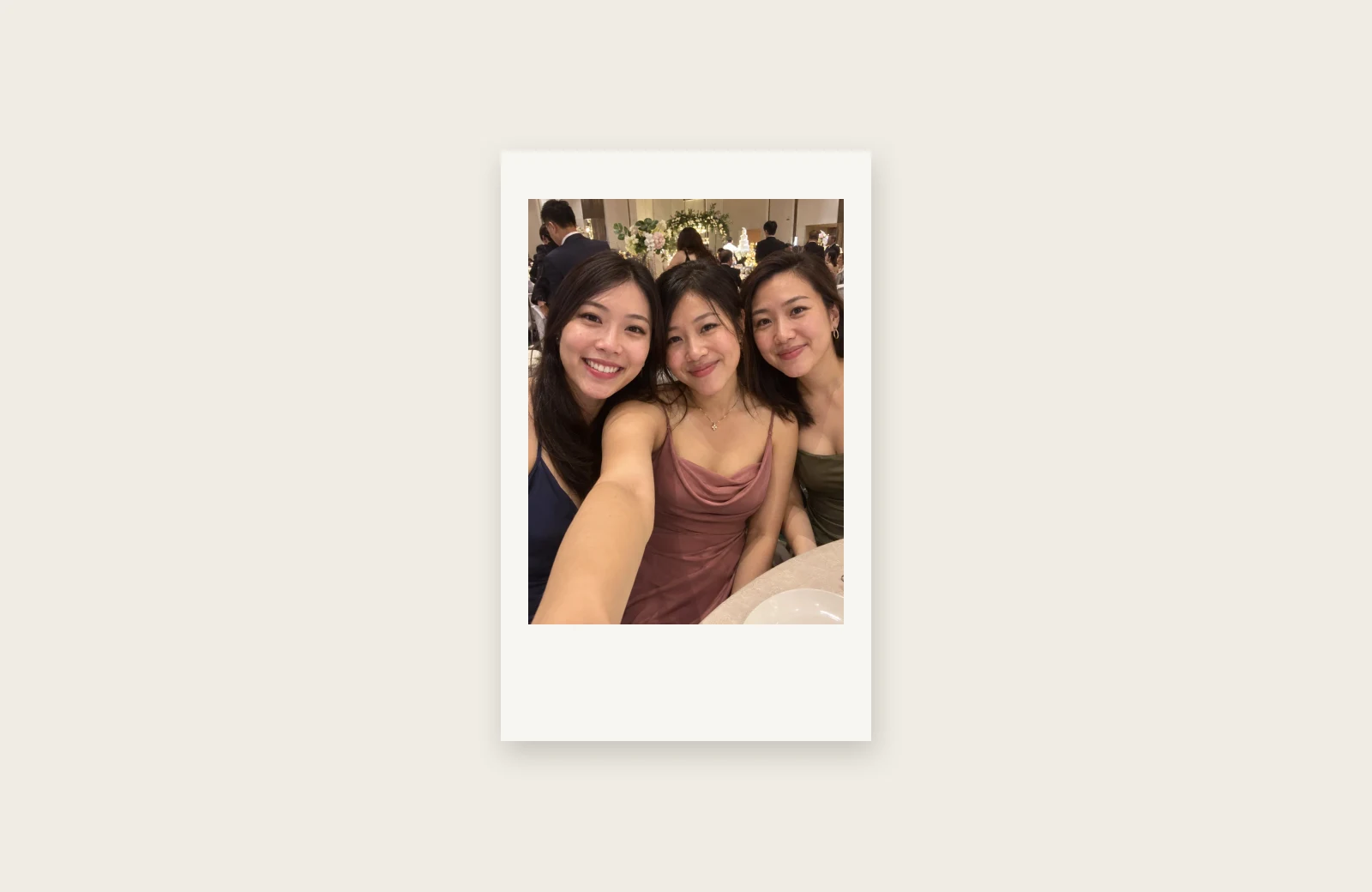
A 20-shot twin pack costs about S$24–26, roughly S$1.20–1.30 a photo. Someone has to hold the camera, change film every 10 shots and look after it through the evening.
Choose Instax if you want colour and have a friend or helper to run the camera. The booth, roving photographer and Instax comparison covers setting up a guest-run Instax table.
Polaroid: larger square pictures
Polaroid i-Type film makes a 79 × 79 mm square picture that takes 10–15 minutes to develop. A pack of 8 costs about S$26.90, roughly S$3.36 a photo.

It's the slowest and priciest of the three per photo, and the film is best kept cool until you use it. Choose Polaroid if you love the square frame and want fewer, larger pictures, perhaps for a guestbook you fill with friends.
How to choose between them
- Thermal: most guests joining in, prints in seconds, your names and date on every print, and a digital copy of every photo
- Instax Mini: small colour photos on a modest budget, with a helper to run the camera
- Polaroid: fewer, bigger square photos, with room on the border for a message
More about instant prints
Instax or Polaroid: which is better?
For most events, Instax. It costs less per photo, develops in about 90 seconds and the camera is smaller. Choose Polaroid when you want the larger square picture and don't mind 10–15 minutes of developing and a higher film cost.
Which is best for a wedding guestbook?
Polaroid's wide bottom border leaves the most room for a written message, and Instax suits a smaller book. A thermal photobooth adds a digital guestbook, so every photo and message is saved even if you also keep a physical album.
Which costs less per photo?
Thermal, by a long way. Paper costs a fraction of film, so guests don't ration shots the way a 10-shot Instax pack or 8-shot Polaroid pack makes them. A hired thermal photobooth's quote also covers the operator, design and digital guestbook.
Do thermal prints last as long as instant film?
No. Instant film is made to be kept as a photograph, while thermal paper is sensitive to heat and sunlight. Stored cool, dry and dark, thermal prints can stay readable for years, and every Monotone photo is also kept in the digital guestbook.
Planning an event?
Get in touch for availability and pricing.
Contact usSee the Monotone receipt photobooth